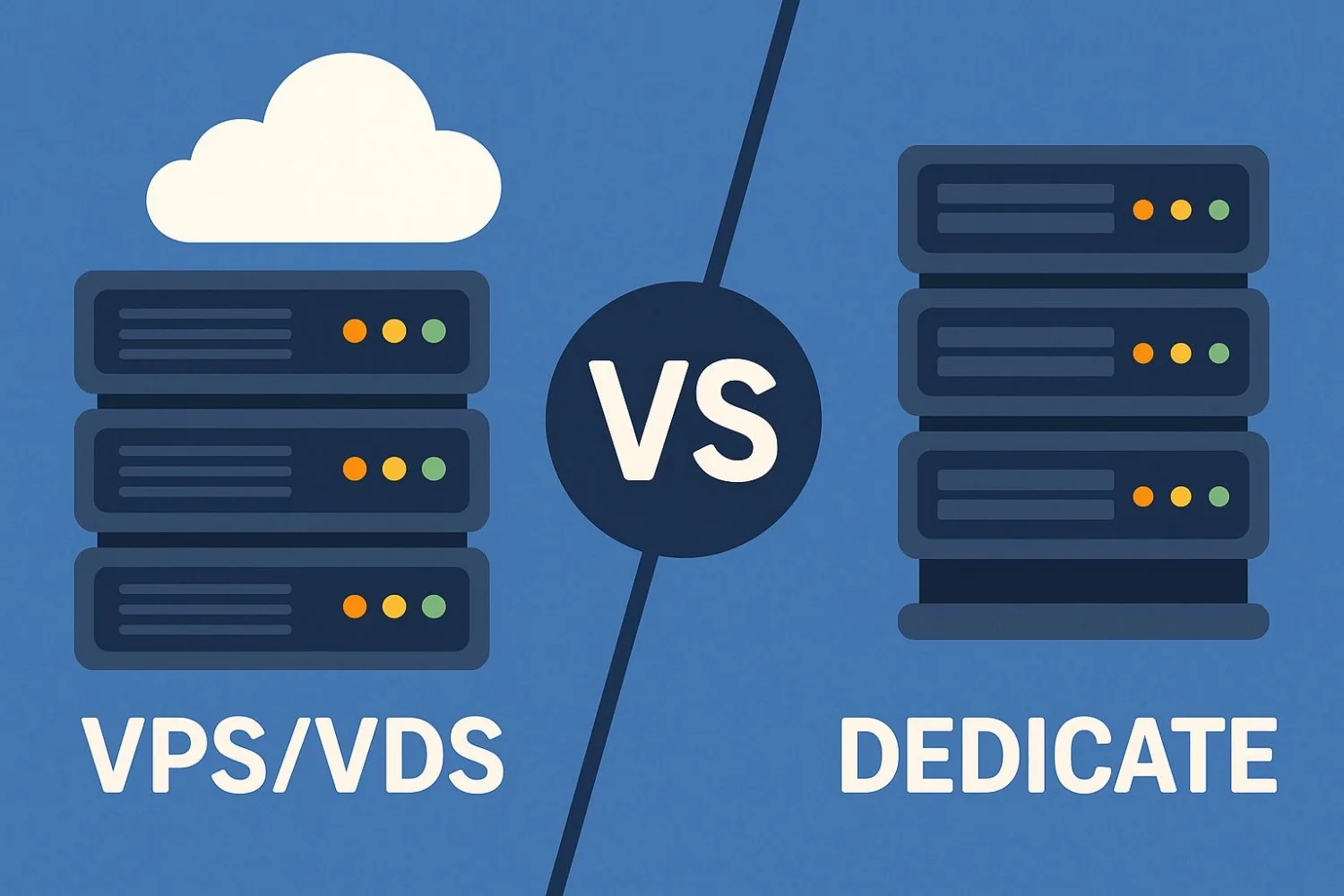
A VPS (Virtual Private Server) is a virtual machine running on a physical host shared with other VPS tenants. A dedicated server is an entire physical machine reserved for a single customer. Both can host websites and applications, but dedicated hardware becomes the preferred option when performance consistency and peak capacity matter.

1) Real performance and predictable resources
On a VPS you get allocated vCPU/RAM/storage, yet the underlying CPU and I/O subsystem are shared. Under heavy load, you may encounter “noisy neighbor” effects: latency spikes and reduced IOPS when other tenants consume host resources.
A dedicated server is typically more powerful and more predictable because CPU cores, memory channels, and storage are exclusively yours—ideal for:
-
database-heavy workloads (PostgreSQL/MySQL),
-
high-traffic APIs and e-commerce,
-
build pipelines (CI/CD) and background processing,
-
virtualization hosts (running your own VMs).
2) Isolation and security
Hypervisors provide strong isolation, but dedicated adds physical isolation, reducing shared risk surfaces and simplifying security controls, segmentation, and audits.
3) Customization and control
Dedicated servers allow deeper tuning: RAID/storage layouts, filesystem choices, kernel/sysctl tuning, network policies, and sustained I/O configurations—useful for performance-sensitive systems.
4) Cost efficiency at scale
VPS is cost-effective for MVPs, small projects, and fast deployment. However, once you scale to multiple large VPS instances, total cost can approach dedicated pricing while performance predictability remains lower. For many businesses, dedicated becomes the better long-term value.